
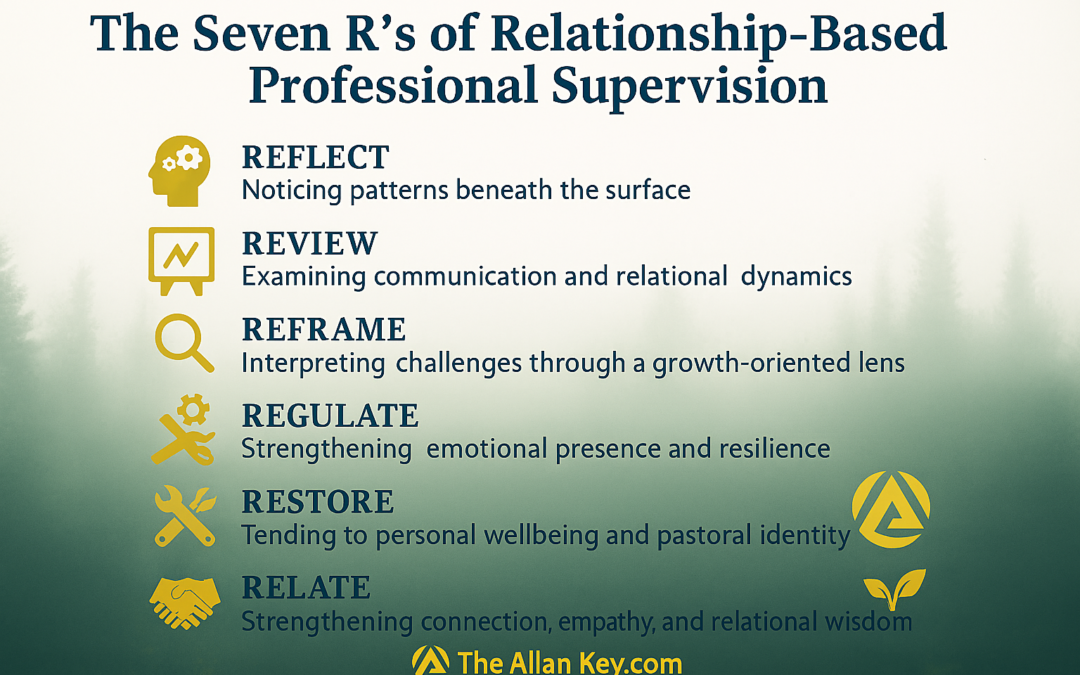
1. REFLECT — noticing patterns beneath the surface
Invite your supervisee to explore the emotional, relational, and behavioural patterns shaping their work, much like attachment‑based models help individuals see how early bonds influence present reactions.
Quote: “Your current reactions have an attachment history.” — Psychology Today
Purpose: Helps your supervisee identify internal drivers that influence their responses to people and pressures. [helpguide.org][psychologytoday.com]
2. REVIEW — examining communication and relational dynamics
Use relational frameworks (Gottman, Love Languages, Prepare/Enrich) to help your supervisees review how they communicate, resolve conflict, and either turn toward or away from others in their ministry or leadership contexts.
Quote: “Small daily moments matter more than grand romantic gestures.” — Gottman research summary
Purpose: Builds awareness of interaction habits that strengthen or strain relationships. [southdenve…herapy.com], [simplypsychology.org][southdenve…herapy.com]
3. REFRAME — interpreting challenges through a growth‑oriented lens
Draw from Prepare/Enrich and EFT principles to help your supervisees reinterpret stress points not as failure but as opportunities for clarity, emotional engagement, and skill‑building.
Quote: “EFT aims to restore the emotional bond as the best lever for change.” — Psychology Today
Purpose: Encourages constructive meaning‑making rather than self‑criticism. [florecerfa…seling.com], [psychologytoday.com][psychologytoday.com]
4. REGULATE — strengthening emotional presence and resilience
Integrate insights from EFT and reflective supervision to support emotional regulation, preventing “flooding” or overwhelm in relational ministry situations.
Quote: “Emotional responsiveness—tuning into and supporting the other—is the key defining element of love.” — Sue Johnson
Purpose: Encourages grounded, thoughtful presence in emotionally charged environments. [gottman.com], [reflective…actice.org][psychologytoday.com]
5. RESTORE — tending to personal wellbeing and pastoral identity
Use restorative supervision principles to address fatigue, emotional residue, and compassion strain, allowing your supervisees to recover inner safety and clarity.
Quote: “Supervision provides an environment to explore your personal and emotional reactions to your work.” — Diocese of Truro
Purpose: Protects the supervisee’s emotional, spiritual, and vocational health. [trurodiocese.org.uk]
6. RELATE — strengthening connection, empathy, and relational wisdom
Draw on relationship research (Gottman, attachment theory, Love Languages) to help your supervisees improve their relational intelligence and empathic engagement.
Quote: “Partners who stay together respond to bids for connection 86% of the time.” — Gottman Method summary
Purpose: Deepens the supervisee’s relational capacity with colleagues, congregants, and community. [helpguide.org], [simplypsychology.org] [southdenve…herapy.com]
7. RENEW — aligning practice with values, purpose, and spiritual formation
Building on reflective supervision literature, guide your supervisee toward renewed clarity in vocation, values, boundaries, and direction.
Quote: “Reflective supervision strengthens the whole professional.” — NCRSP
Purpose: Integrates spiritual, emotional, and professional growth into a sustainable, meaningful rhythm. [wesley.cam.ac.uk], [link.springer.com] [reflective…actice.org]