
When Stress Starts to Change You
Sometimes it doesn’t feel like stress. It feels like irritation. Like snapping more quickly than you used to. Like your patience has quietly thinned.
You’re still functioning.
You’re still responsible.
You’re still showing up.
But something feels… tighter. Under the surface.
The Quiet Role of Cortisol
Cortisol is often labelled the “stress hormone,” but it’s not the enemy. It wakes you up in the morning. It helps you respond under pressure. It sharpens focus when something matters. In short bursts, it’s protective.
But cortisol was designed for short-term stress — not months of pushing through, carrying responsibility, holding things together, and sleeping lightly.
When pressure becomes constant, cortisol can remain elevated. And over time, that changes how you feel.
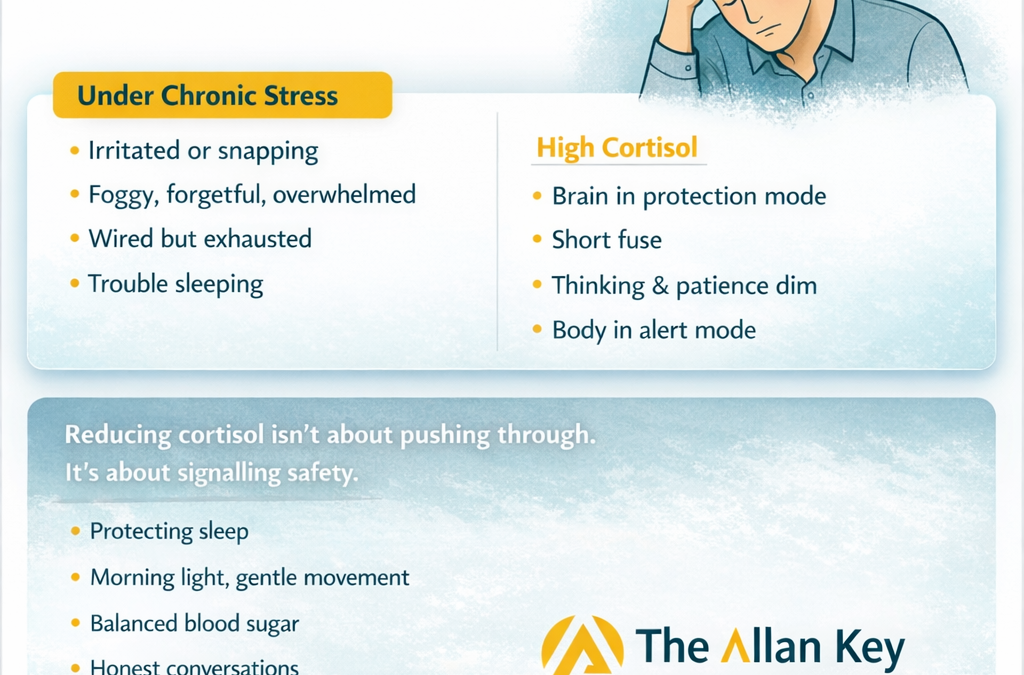
What High Cortisol Can Feel Like
It’s not always dramatic.
Sometimes it looks like:
• Irritation just under the surface
• Anger that surprises you
• Feeling overwhelmed by noise or demands
• Brain fog
• Forgetting small things
• Waking between 2–4am
• Digestive discomfort
• Feeling “wired” but exhausted
Many people describe it quietly:
“I don’t feel like myself lately.”
That can be unsettling. But it isn’t weakness. It’s a nervous system that hasn’t had a chance to settle.
When cortisol stays high, your brain shifts into protection mode.
The threat system gets louder.
The thinking, regulating part gets a little quieter.
So your tolerance narrows. Your reactions speed up. Your emotional bandwidth shrinks. Your body is trying to keep you safe. It just hasn’t realised the pressure is ongoing.
Reducing Cortisol Isn’t About Trying Harder
You don’t lower stress hormones by pushing through. You lower them by signalling safety. Small, consistent actions matter more than dramatic change:
• Protecting sleep like it’s medicine
• Getting morning light
• Gentle movement and strength training (without overtraining)
• Slow, steady breathing
• Eating in a way that stabilises blood sugar
• Saying no where you can
• Having honest conversations instead of swallowing stress
Often, it’s not about becoming more resilient.It’s about recovering. Sometimes high cortisol is simply the cost of being strong for too long.
Is This You?
Take a quiet moment and notice:
• ☐ I’ve been more irritable than usual
• ☐ Small things feel disproportionately big
• ☐ My sleep is lighter or broken
• ☐ I feel wired but tired
• ☐ My thinking feels foggy
• ☐ I’m reacting faster than I’d like.
If you ticked a few, it doesn’t mean something is wrong with you. It may mean your system needs care.
Cortisol responds to safety. The nervous system recalibrates. Clarity returns. And when it does, you don’t just cope. You feel steady again.
If any of this feels familiar, take a breath. Nothing here suggests you’re failing or falling behind. It may simply mean your nervous system has been carrying more than it was designed to carry for too long.
Sometimes understanding what’s happening inside the body is the first step toward steadiness.
Cortisol settles when safety returns.
Clarity follows rest. And with the right support and small, consistent changes, the system can recalibrate. There is a way back to feeling like yourself again.
At theallankey.com, we create space for conversations like this. Gentle, honest, practical. If you’d like to explore how to move from survival mode back to steadiness, you’re always welcome to reach out for a quiet conversation.
No pressure.
Just support.
Wendy Ann Brown