
Over the years, I’ve watched Gallup Strengths unlock confidence, clarity, and momentum in people who had long felt unseen or misunderstood. I’ve also watched it subtly become a mirror people admire rather than a window through which they see God. Like most tools, its power lies not in what it is, but in how it is held.
So what does a biblical lens reveal? Let’s consider both the case for—and the case against.
The Case For Gallup Strengths
At its best, Gallup Strengths names what God has already placed within us. Scripture is clear: we are created with intention, not accident.
“For we are God’s handiwork, created in Christ Jesus to do good works.”
— Ephesians 2:10 (NIV)
Strengths language helps people articulate how they naturally contribute—how they think, feel, and act when they are at their best. That naming can be profoundly freeing, especially for those who have spent years trying to be someone else.
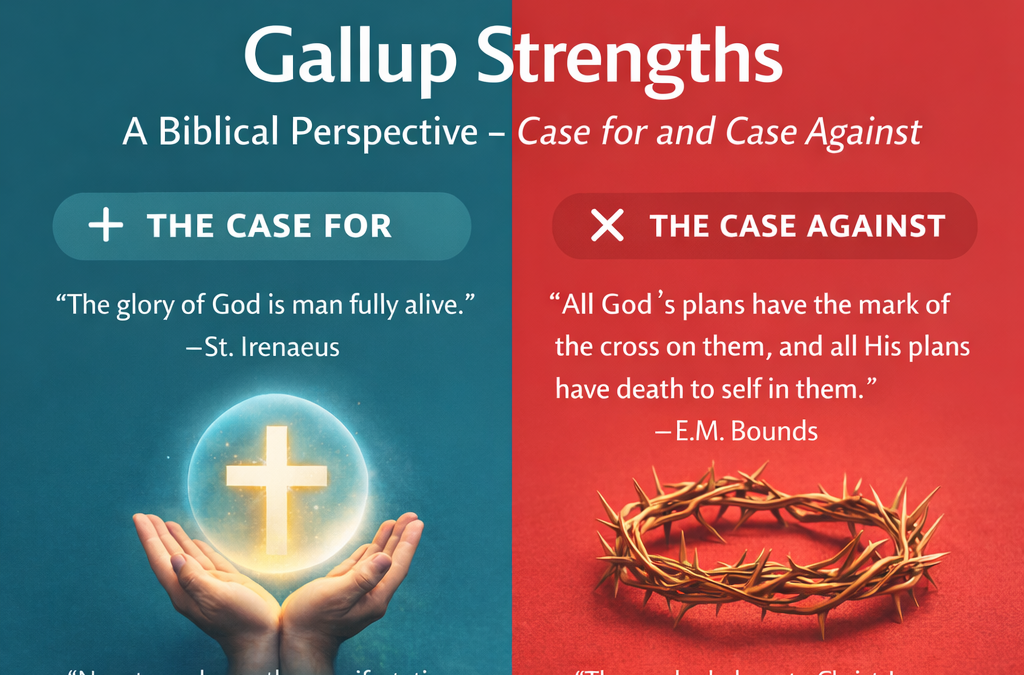
St. Irenaeus captured this beautifully:
“The glory of God is man fully alive.”
When people understand their wiring—whether it’s Achiever energy, Relator depth, or Strategic pattern‑recognition—they often move from shame to stewardship. Not pride. Stewardship.
Paul reminds us:
“Now to each one the manifestation of the Spirit is given for the common good.”
— 1 Corinthians 12:7 (NIV)
Notice the emphasis: given, not earned. For the common good, not personal brand. Strengths, rightly understood, become a vocabulary for service. They help leaders place people well, couples understand each other more deeply, and teams honour diversity rather than compete for dominance.
Used this way, Gallup Strengths doesn’t replace spiritual formation—it supports it.
The Case Against Gallup Strengths
And yet… Scripture also offers a warning.
Tools that begin as servants can quietly become masters.
When strengths become identity rather than instrument, formation gives way to self‑justification. “That’s just how I’m wired” replaces repentance. Self‑awareness displaces surrender.
E.M. Bounds offers a sobering counterweight:
“All God’s plans have the mark of the cross on them, and all His plans have death to self in them.”
Jesus does not invite us to maximise ourselves. He invites us to lose ourselves.
“Those who belong to Christ Jesus have crucified the flesh with its passions and desires.”
— Galatians 5:24 (NIV)
The danger is subtle: strengths language can reinforce what the gospel seeks to transform. Achievers can baptise drivenness. Influencers can spiritualise control. Thinkers can hide from obedience behind insight.
Oswald Chambers once warned:
“The most difficult thing to give up is the right to myself.”
Gallup Strengths does not measure pride, humility, obedience, or love. It cannot discern the difference between giftedness submitted to God and giftedness serving self. That work belongs to the Spirit—and to community.
Holding the Tension
So where does that leave us?
Gallup Strengths is a tool, not a theology. A map, not a compass. Helpful when it leads us toward service, dangerous when it becomes a shrine to self.
The better question is not “What are my strengths?”
But “How are my strengths being crucified, redeemed, and offered back to God?”
That question changes everything.
— TheAllanKey.com