
Leadership—whether in ministry, business, or community—carries both potential and pressure.
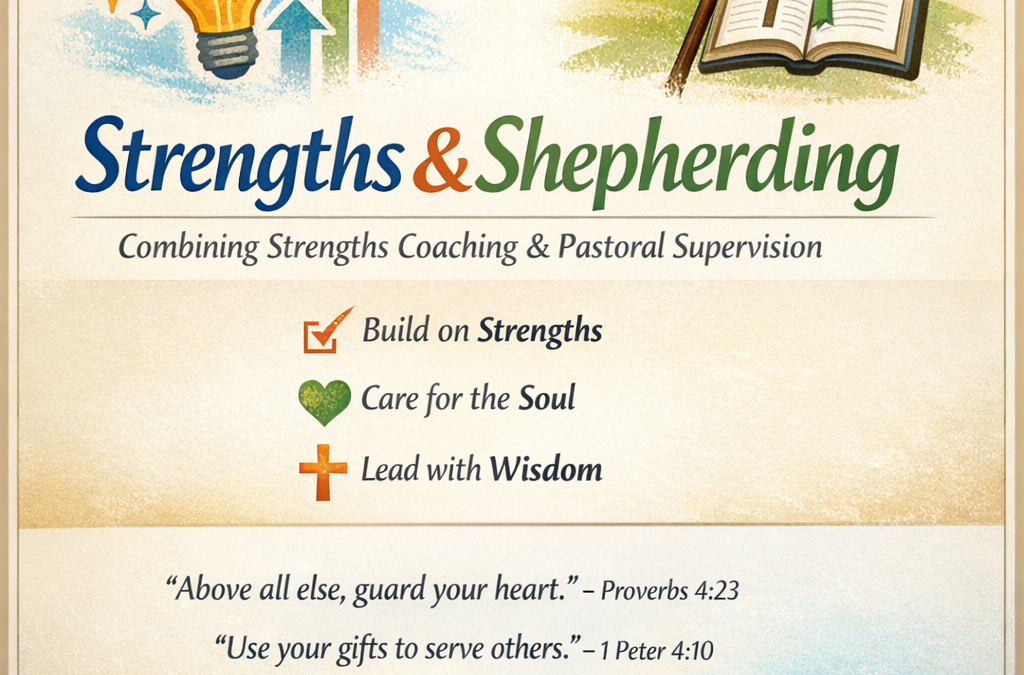
Strengths Coaching helps leaders name and aim what’s strong. Pastoral Supervision creates a safe, reflective space to explore what’s heavy. When combined, they form a deeply human and spiritually grounded approach to growth.
Strengths Coaching begins with hope. It asks, What has God already placed within you? By identifying patterns of talent and energy, leaders gain language for why they lead the way they do and how they are most effective.
As Marcus Buckingham notes, “People don’t change by fixing their weaknesses; they change by building on their strengths.”
Strengths invite clarity, confidence, and intentional contribution.
Pastoral Supervision, however, asks a different—but equally vital—set of questions:
What is this role costing you?
Where are you carrying unseen strain?
How is your soul really doing?
It slows leaders down long enough to notice emotions, spiritual movements, ethical tensions, and relational dynamics.
Henri Nouwen captured this beautifully: “The great illusion of leadership is to think that man can be led out of the desert by someone who has never been there.”
Together, these two disciplines prevent distortion.
Strengths without supervision can become overused gifts—drive turning into burnout, empathy into over‑responsibility, vision into isolation.
Supervision without strengths can drift into problem‑saturation. Combined, leaders are both affirmed and anchored.
This integration also reframes supervision from “something is wrong” to “something is forming.” Leaders learn to ask richer questions:
• Which strengths are life‑giving right now—and which are overextended?
• What is God shaping in me through this challenge?
• Who am I becoming as I lead?
As Peter Drucker observed, “The best way to predict the future is to create it.”
Strengths Coaching helps leaders create with intention; Pastoral Supervision ensures that creation remains faithful, healthy, and sustainable.
Scripture reminds us that formation matters as much as function. “Above all else, guard your heart, for everything you do flows from it” (Proverbs 4:23).
“Each of you should use whatever gift you have received to serve others” (1 Peter 4:10).
And “He restores my soul; He leads me in paths of righteousness” (Psalm 23:3).
When strengths are stewarded and the soul is tended, leaders don’t just perform better—they endure better.
That is leadership with depth, direction, and grace.
Blessings
Allan